Porsche, Aston Martin, Bentley, Armani, Missoni, Waldorf Astoria. The list keeps growing. The Real Deal counts 66 branded projects in South Florida, backed by some 40 brands. In Brickell it will soon be easier to find a tower with a logo than one without.
The formula made sense. Miami's buyer usually lives far away: from Santiago or São Paulo, they buy an apartment that is still a rendering, from a developer they do not know. The brand provides trust; almost without noticing, the buyer assumes that if the brand is good, the project will be too. That is why developers pay a license of 2% to 4% of the sales price. The brand also speeds up presales and reassures the lenders and investors financing construction.
A signal only works while it is scarce
The problem is that when every tower has a brand, none stands out. Oversupply turned a sales and pricing strategy into something ordinary. And the brand is no guarantee of appreciation or of quality.
To measure it, I went to the public record. I matched the Miami-Dade Property Appraiser with the MLS and compared, unit by unit, the price of every resale in the past year with what that same unit paid at presale.
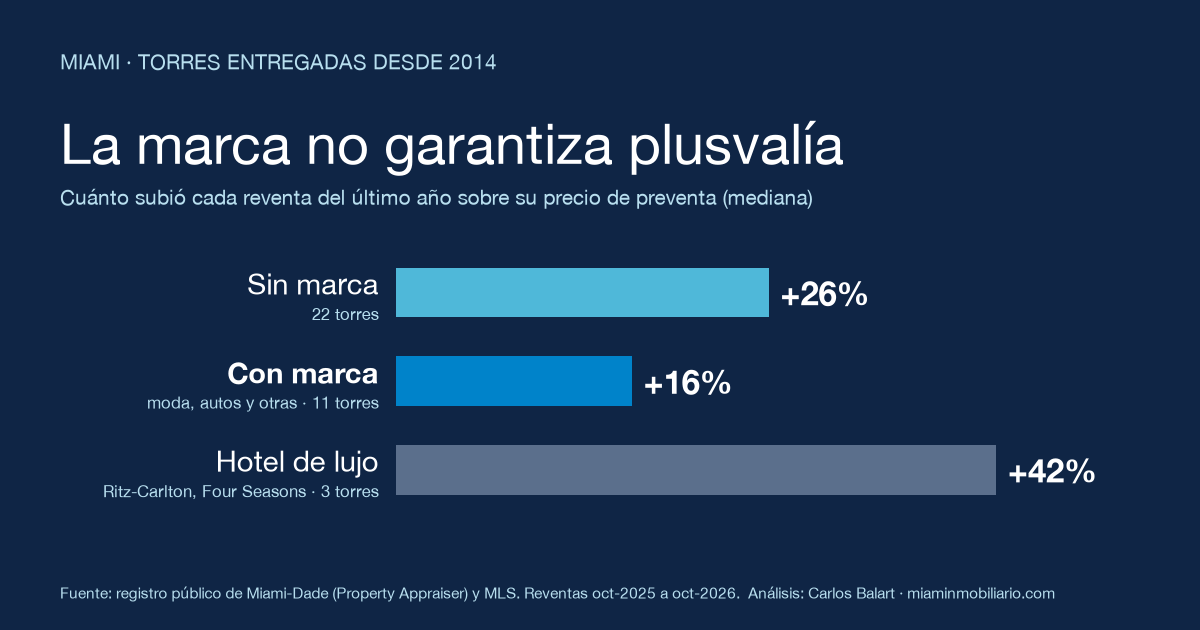
I compared 11 branded towers with non-branded towers of the same area and vintage. In eight, the non-branded one appreciated more. Two towers contemporary to Missoni Baia, in Edgewater, appreciated 24%; Missoni, 12%. And time does not help: at Porsche Design Tower in Sunny Isles, delivered ten years ago, nine of the 11 resales in the past year closed below the presale price.
Lawsuits at the Aston Martin tower
Another car-branded tower, Aston Martin Residences downtown, faces two lawsuits from its owners: one for fraud and for failing to deliver what was promised, such as a marina and a helipad; another over cracked concrete, exposed rebar and leaks. The developer denies the allegations. Meanwhile, one in six apartments in the building is for sale.
The exception: a real hotel
There is one exception, and it is worth understanding why. Residences tied to a luxury hotel operating in the same building, such as Ritz-Carlton or Four Seasons, did outperform: +42% median, and only one resale at a loss out of 35. There the brand is not just a logo on the façade: it is a daily service the owner uses and the next buyer pays for too.
Why the formula never caught on in Chile
The best-known case is W Residences, 46 apartments above the W hotel in El Golf, launched in 2009. Since then, the formula has not caught on. The Chilean buyer is moved by other things: they know the neighborhood and the developer, and they look at the plans and the finishes in the model unit. The developer's name is already the brand. Personality matters too: the affluent Chilean is sober and low-profile. They may have a German car in the garage and a Swiss watch worth thousands, but they do not want to live in a building named after a car or an Italian fashion house.
That is the lesson for the Latin American buyer in Miami. A brand is a tool for selling to a stranger who buys from a distance. Before paying for it, ask what you will receive once the launch party is over. If the answer is only a name on the façade, you are paying for the trust you lack.
Read it in El Diario Inmobiliario →
Frequently asked questions
What is a branded residence?
A residential building that carries the name of a luxury brand — a hotel, a car maker, a fashion house — under license. The developer pays to use the name, typically 2% to 4% of the sales price, and sometimes a services contract if the brand operates the building.
Do branded condos appreciate more in Miami?
Not as a rule. In Miami-Dade public records, towers with fashion, car or other brands delivered since 2014 appreciated a median 16% on past-year resales, versus 26% for non-branded towers. The exception is residences of luxury hotels operating in the building, such as Ritz-Carlton or Four Seasons, at +42%.
What should I check before buying in a branded tower?
What concrete service the brand delivers after the sale, what resales fetch in already-delivered towers of the same brand, how many units in the building are for sale, and whether the owners' association has open lawsuits. All of it is in public records.
Sources: Miami-Dade Property Appraiser (sales history by unit) and MIAMI REALTORS MLS (closings and listings), processed by Carlos Balart, resales Oct-2025 to Oct-2026; The Real Deal (South Florida branded residences map); Aston Martin Residences association lawsuits (Feb. and Apr. 2026). Photo: "Porsche Design Tower November 2016", Carl Lender (Wikimedia Commons, CC BY 2.0).
This note is reference analysis and does not replace legal, tax or financial advice. We advise buyers with data, on the buyer's side — not the developer's.